
Technology
LFP Batteries
Lithium iron phosphate chemistry: why it became the domestic standard, and what it gives up in exchange.
What LFP means
Lithium iron phosphate, sometimes written LiFePO4. It describes the cathode material — the positive electrode — inside the cell. All lithium-ion cells move lithium ions between two electrodes; what varies is what those electrodes are made of, and that choice determines nearly everything about how the cell behaves.
LFP uses iron and phosphate. The main alternative family in consumer use, nickel manganese cobalt and its relatives, uses exactly what its name suggests.
Why static storage chose it
A battery in a car and a battery on a garage wall are solving different problems.
An electric vehicle carries its battery, so every kilogram of cell weight costs range. It needs the highest energy density available, and it will accept a shorter cycle life and a more demanding thermal management system to get it.
A home battery does not move. Its weight is irrelevant beyond the wall fixing, and its volume matters only if the space is tight. What it needs instead is a long cycle life — it charges and discharges most days for many years — and a cathode that behaves predictably when something goes wrong.
LFP gives up energy density and gains both of those. That is why home storage converged on it, and why the trade-off is a sensible one rather than a compromise.
The thermal point, stated accurately
The LFP cathode is more thermally stable than nickel-based cathodes: it begins to break down and release oxygen at a higher temperature, which raises the threshold at which a cell can enter thermal runaway. This is a real and measurable difference and it is the main reason the chemistry dominates static storage.
It is not a claim that the battery cannot fail. Every domestic battery relies on a management system watching cell voltage and temperature, on installation to the manufacturer’s clearances, and on siting that respects ventilation and access requirements. We install to those requirements and we do not describe any battery as risk-free.
Cold weather behaviour
The one genuine LFP weakness in a British installation. Charging lithium cells below a low temperature threshold causes lithium plating on the anode, which permanently reduces capacity. Manufacturers therefore restrict or block charging below a stated temperature.
In practice this means an unheated, uninsulated garage or an outbuilding can leave the battery unable to charge on cold winter mornings — precisely when a cheap overnight tariff would be most useful. Some products include internal heating to manage this; some do not. It is a survey question, and the answer belongs in the design rather than in a phone call in January.
Suitability
LFP is the appropriate chemistry for almost all UK domestic storage. The situations where it is awkward are those where space is tight enough that the larger cabinet does not fit, or where the only available location is cold and cannot be insulated.
Installation implications
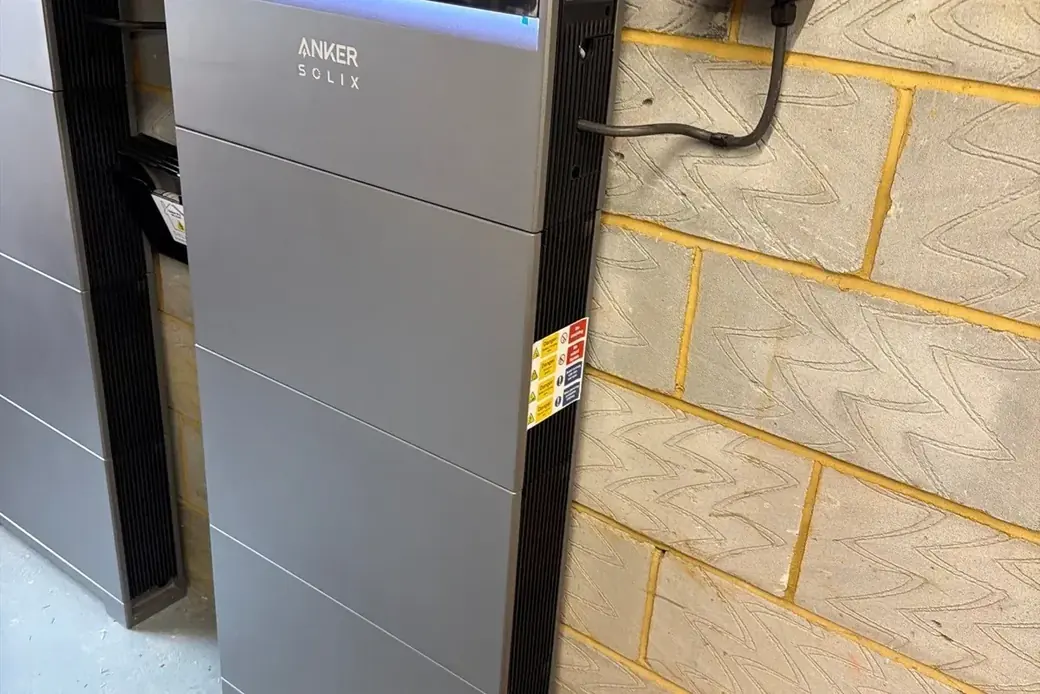
Expect a larger and heavier unit than an equivalent nickel-based product. That drives the practical decisions: floor loading or wall construction, clearance around the cabinet for airflow and service access, cable routes to the inverter, and a location within the stated temperature range.
Warranty and cost
LFP warranties are typically structured as a term plus an energy throughput or cycle limit, with a guaranteed retained capacity at the end. Read all three parts, because the limit that expires first is the one that governs.
On cost, LFP is generally competitive per kWh, helped by high production volume and the absence of cobalt. The specific chemistry, module capacity, temperature limits and warranty terms of the battery we propose are stated in your written quotation with the manufacturer’s datasheet attached.
Specification considerations
These are the figures worth comparing when you are reading a quotation. The exact values for the products specified for your installation come from the manufacturer's current datasheet and are stated in your written quotation.
| What to look at | Why it matters |
|---|---|
| Chemistry | Lithium iron phosphate cathode, usually written LFP or LiFePO4 |
| Nominal cell voltage | Around 3.2V per cell, lower than nickel-based lithium chemistries |
| Energy density | Lower per kilogram and per litre than nickel-based lithium, so the cabinet is larger for the same capacity |
| Thermal behaviour | A more stable cathode with a higher thermal runaway threshold than nickel-based chemistries |
| Cycle life | Generally rated for more full cycles than nickel-based lithium; the warranted figure is product-specific |
| Cobalt content | None — the cathode uses iron and phosphate rather than cobalt or nickel |
| Cold weather behaviour | Charging is restricted below a stated low temperature; many products include a heater or a charge inhibit |
Where it works, and where it does not
Strengths
- A more thermally stable cathode than nickel-based lithium chemistries, which is why it dominates static home storage
- Typically rated for a higher number of cycles, which suits a battery that charges and discharges daily
- No cobalt in the cathode, removing a material with a difficult supply chain
- Tolerates being held at high state of charge better than nickel-based chemistries, which suits overnight tariff charging
- Widely produced, so supply, replacement modules and installer familiarity are all straightforward
Limitations
- Lower energy density, so an LFP cabinet is physically larger and heavier than a nickel-based one of the same capacity
- Charging is restricted at low temperature, which matters in an unheated garage in a UK winter
- Flat voltage curve makes state of charge harder to measure precisely, so the reported percentage can move in steps
- Capacity still fades with age and cycling; no chemistry is immune to degradation
- Slightly lower round-trip efficiency than the best nickel-based cells in some operating conditions
This page covers one component. For how the whole thing fits together, see solar panels and battery storage.
Common questions
Why is LFP used for home batteries rather than the chemistry in EVs?
Different priorities. A car needs the most energy per kilogram it can get, because weight costs range. A battery bolted to a garage wall does not care what it weighs, so it can use a chemistry that trades density for thermal stability and cycle life. That trade is exactly what LFP offers, which is why static storage settled on it.
Is LFP safer?
It is more thermally stable — the cathode releases oxygen at a higher temperature than nickel-based chemistries, which raises the threshold for thermal runaway. That is a meaningful engineering difference, not an absolute claim. Any lithium battery needs a competent battery management system, correct installation, and siting that respects the clearances and temperature range in the manual.
Will an LFP battery work in a cold garage?
It will discharge in the cold, but charging below a stated temperature is restricted or blocked to protect the cells. Products handle this differently: some include internal heating, some simply inhibit charging until the cells warm. If the intended location is unheated and exposed, we check the specific product's temperature limits at survey rather than discovering the restriction in January.
How many cycles will it do?
More than most households will use in the warranty period, since a solar-plus-tariff battery typically completes roughly one to two cycles a day. Manufacturers state a cycle rating and warrant a retained capacity against a term and a throughput limit. Those numbers vary by product and are on the datasheet supplied with your written quotation.
Related services
- Battery storage installationHome battery systems sized against your consumption, sited properly and commissioned with the tariff in mind.
- Solar and battery systemsPanels, hybrid inverter and storage designed as one system, on one scaffold, with one commissioning.
- Battery retrofitAdding storage to a solar system that is already on the roof, without disturbing what works.
The technology behind it
- BatteriesHow home storage works, what determines whether it pays, and the specifications that actually matter.
- Battery sizingHow storage capacity and power rating are calculated from consumption data rather than from roof size.
- Hybrid invertersA single unit managing array, battery and house demand, and when fitting one is worth the extra cost.
- Monitoring systemsWhat generation, consumption and battery data actually tells you, and what a system needs fitted to produce it.
Property and roof guides
- Post-1965 homesTrussed rafter roofs, concrete interlocking tile and modern electrics — the most straightforward housing stock to work on.
- BungalowsLarge roof area over a small floor plan, low eaves and easy access — with shading and consumption as the real limits.
- Barn conversionsLarge uninterrupted roof planes, profile sheet or clay tile, long cable runs and rural supplies that shape what is possible.
See it on a real installation
- A battery upgrade that became a full system rebuild, East HorsleyThe enquiry was for another 15kWh of storage. The survey found four roof orientations sharing two MPPTs, and the honest answer was to rebuild from the roof upwards.
- Solar, storage and EV charging in Padworth, BerkshireA whole-home energy system on an established tiled roof — solar PV, battery storage, EV charging and a surplus diverter for hot water.
Further reading
Where we work
Information reviewed on 2026-08-23.
Not sure which specification suits your roof?
We design around the property rather than fitting the same system to every house. Tell us the postcode and we will explain what we would specify and why.
Ask us about specification
No obligation. We will review the details, come back to arrange the next step, and issue a written design and fixed quotation before anything is agreed.
Prefer to talk? Call 0118 227 7444.