
Technology
Home Battery Storage
How home storage works, what determines whether it pays, and the specifications that actually matter.
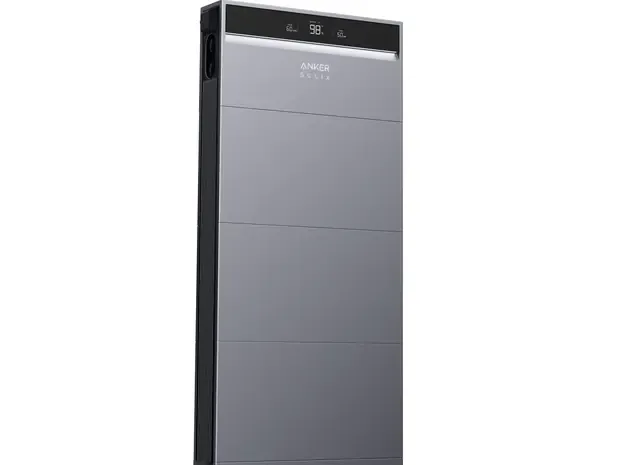
Product image supplied by Anker SOLIX. An example of a modular stacking battery system.
What a home battery is
A cabinet or wall unit containing lithium cells, a battery management system, and the electronics that connect it to an inverter. The management system is not an accessory — it monitors every cell’s voltage and temperature, balances them, and refuses to charge or discharge outside safe limits. It is the reason a domestic battery is a product rather than a pile of cells.
How storage changes a solar system
Without storage, generation you cannot use at the moment it is produced goes to the grid. Export is paid, but at a rate well below what you pay to import. A battery moves that surplus a few hours forward, from midday when nobody is home to the evening when the oven, the kettle and the television are all on.
That is the solar case. There is a second, separate case that has nothing to do with solar: on a tariff with a cheap overnight window, you can fill the battery from the grid at the low rate and run the house from it through the expensive part of the day. In a UK winter, when generation is small, this is often where most of the saving comes from.
A well-controlled battery does both, switching between them according to forecast and tariff.
Capacity, power and the difference between them
Two numbers describe a battery, and confusing them causes most of the disappointment we are asked to investigate.
Capacity (kWh) is how much energy it holds. It determines how long the battery can cover demand.
Power (kW) is how fast it can charge or discharge. It determines what it can cover. A battery with a modest power rating may hold ample energy but be unable to supply an electric shower and an oven simultaneously, so the grid tops up the difference.
Note also that usable capacity is lower than nominal capacity, because the management system holds back a reserve at both ends of the range to protect cell life. Compare quotations on usable figures.
Coupling
DC-coupled through a hybrid inverter, where solar charges the battery with one conversion. More efficient, and the normal approach on a new installation.
AC-coupled through a separate battery inverter, which converts AC back to DC to charge. A few per cent less efficient, but the right answer when you already have a working solar inverter and replacing it would be wasteful.
Suitability
A battery suits a household that exports a lot, pays a high import rate, or has access to a time-of-use tariff. It suits homes with an EV or a heat pump, where consumption is large enough to make the arbitrage worth having.
It suits poorly a household that already uses nearly everything it generates during the day, or one on a flat tariff with a good export rate and low consumption. In that case the honest advice is to spend the money elsewhere, and we give it.
Installation implications
Weight and space come first — these are heavy units needing a sound wall or solid floor and stated clearances. Temperature range matters: an uninsulated garage that drops close to freezing will restrict charging on some products. Cable routes to the inverter and to the consumer unit need planning, and adding storage may move the connection from a G98 notification to a G99 application requiring DNO approval before work starts.
Warranty and cost
Battery warranties are not simple periods. They usually combine a term, an energy throughput or cycle limit, and a retained-capacity percentage at the end. Read all three — a long term with a low throughput limit may expire on usage rather than on time.
Cost scales with capacity but not proportionally, since installation and inverter costs are largely fixed. That is why adding a second module is usually cheaper per kWh than the first. Your written quotation states usable capacity, power rating and the full warranty terms with the datasheet attached.
Specification considerations
These are the figures worth comparing when you are reading a quotation. The exact values for the products specified for your installation come from the manufacturer's current datasheet and are stated in your written quotation.
| What to look at | Why it matters |
|---|---|
| Typical domestic capacity | From around 5kWh to over 30kWh, usually built up from stackable modules |
| Usable capacity | Less than nominal capacity — the battery management system reserves a margin at each end |
| Power rating | Continuous charge and discharge in kW, which sets how much household demand the battery can cover at once |
| Chemistry | Lithium iron phosphate is the domestic norm; nickel-based lithium chemistries are less common in home storage |
| Coupling | DC-coupled to a hybrid inverter, or AC-coupled through a separate battery inverter |
| Round-trip efficiency | Some energy is lost in each charge and discharge cycle; the figure is stated per product |
| Siting | Garage, utility, plant room or a rated external location, within the product's stated temperature range |
| Warranty basis | Usually a period plus a throughput or cycle limit, with a retained-capacity figure at the end of term |
Where it works, and where it does not
Strengths
- Stores daytime generation for use in the evening, when most households use the most electricity
- Raises the proportion of your own generation you consume rather than export
- Allows cheap off-peak grid import to cover peak-rate demand, which works in winter when solar is scarce
- Can provide backup to selected circuits during an outage where the system is designed and wired for it
- Makes a larger array worthwhile by giving surplus generation somewhere useful to go
Limitations
- Adds significant cost, and the return depends heavily on your tariff and your consumption pattern
- Usable capacity is less than headline capacity, and round-trip losses mean you get out less than you put in
- Capacity falls over the life of the battery; warranties state a retained figure rather than the original one
- Power rating can limit what it covers — a battery may hold plenty of energy but not deliver enough at once for a shower or an oven
- Takes up floor or wall space in a location that meets the product's temperature and access requirements
This page covers one component. For how the whole thing fits together, see solar panels and battery storage.
Common questions
Will a battery pay for itself?
That depends on three things: how much surplus generation you currently export, what your import and export rates are, and whether you can use a tariff with a cheap overnight window. A household exporting a lot at a low export rate and paying a high import rate has a strong case. A household that already uses most of what it generates has a much weaker one. We model it against your actual consumption rather than a national average.
How big a battery do I need?
Usually enough to carry your evening and overnight demand, not enough to make you independent of the grid. Oversizing is the most common mistake we are asked to correct — capacity that never cycles earns nothing. The sizing starts from half-hourly consumption data if you have it, or from annual usage and household pattern if you do not.
How long will a battery last?
Longer than most people expect, but not indefinitely. Capacity fades with cycling and with age, and every manufacturer warrants a retained percentage at a stated number of years or a stated energy throughput, whichever comes first. Those figures vary considerably between products and are on the datasheet issued with your quotation.
Is a battery safe indoors?
Domestic lithium iron phosphate batteries are designed for indoor installation and are subject to product safety standards, with a battery management system monitoring cell voltage and temperature. Siting still matters — clearances, ventilation, temperature range, and keeping it away from escape routes where guidance requires. We assess the proposed location at survey rather than assuming a cupboard will do.
Related services
- Battery storage installationHome battery systems sized against your consumption, sited properly and commissioned with the tariff in mind.
- Solar and battery systemsPanels, hybrid inverter and storage designed as one system, on one scaffold, with one commissioning.
- Battery retrofitAdding storage to a solar system that is already on the roof, without disturbing what works.
- EV charger installationHome charge points installed with a proper load assessment, PEN fault protection and solar-aware scheduling.
The technology behind it
- LFP batteriesLithium iron phosphate chemistry: why it became the domestic standard, and what it gives up in exchange.
- Battery sizingHow storage capacity and power rating are calculated from consumption data rather than from roof size.
- Hybrid invertersA single unit managing array, battery and house demand, and when fitting one is worth the extra cost.
- InvertersWhat the inverter does, how MPPT works, and how the four architectures compare honestly against each other.
- Monitoring systemsWhat generation, consumption and battery data actually tells you, and what a system needs fitted to produce it.
Property and roof guides
- Post-1965 homesTrussed rafter roofs, concrete interlocking tile and modern electrics — the most straightforward housing stock to work on.
- New build homesRetrofitting or extending solar on a new build — structural warranty notification, shallow pitches, interrupted roof planes and covenants.
- 1930s semi-detached homesThe classic suburban semi — hipped or gabled roof, party wall stack, bay window and a side elevation that changes everything.
See it on a real installation
- Solar, storage and EV charging in Padworth, BerkshireA whole-home energy system on an established tiled roof — solar PV, battery storage, EV charging and a surplus diverter for hot water.
- A battery upgrade that became a full system rebuild, East HorsleyThe enquiry was for another 15kWh of storage. The survey found four roof orientations sharing two MPPTs, and the honest answer was to rebuild from the roof upwards.
Further reading
Where we work
Information reviewed on 2026-08-23.
Not sure which specification suits your roof?
We design around the property rather than fitting the same system to every house. Tell us the postcode and we will explain what we would specify and why.
Ask us about specification
No obligation. We will review the details, come back to arrange the next step, and issue a written design and fixed quotation before anything is agreed.
Prefer to talk? Call 0118 227 7444.