
Commercial Solar PV Installation
Rooftop and ground arrays for businesses, designed around the site load profile and the grid connection available.
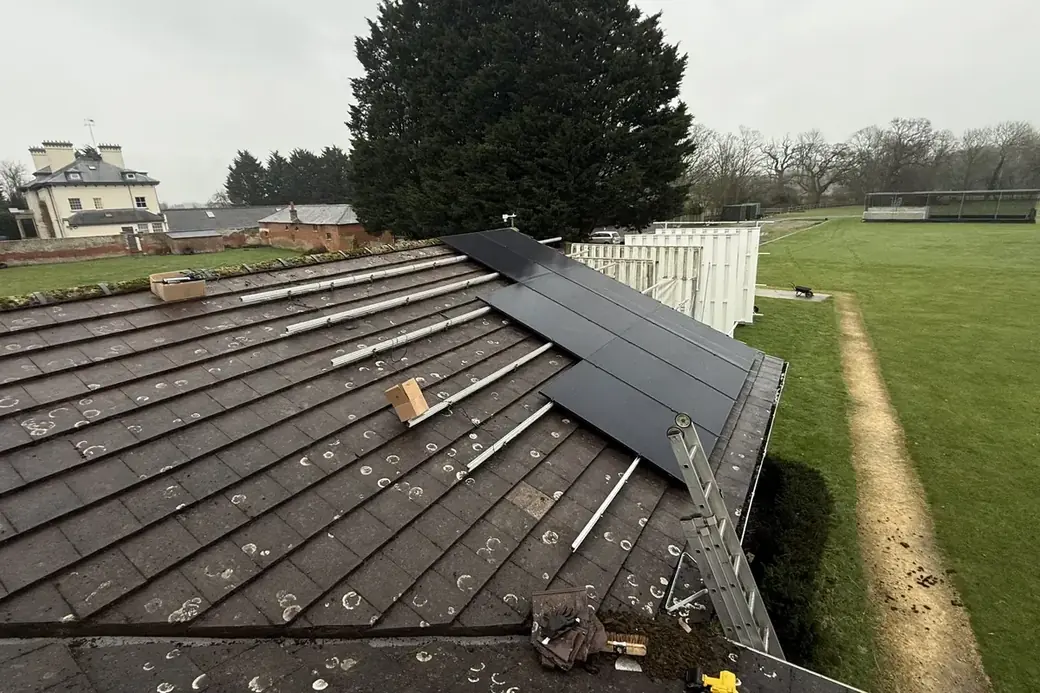
The load profile comes first
A domestic system is designed around a roof and a rough idea of a household’s habits. A commercial system is designed around data, because the data exists.
Half-hourly consumption records from your supplier show the shape of the site: overnight base load, the morning ramp, the weekday plateau, weekend behaviour, and how all of it moves with the seasons. That shape determines the useful array size far more than the roof area does.
The reason is simple economics. Electricity you generate and consume on site displaces import at your full delivered rate, including the non-commodity charges layered on top of it. Electricity you export earns whatever export rate you can secure, which is typically a fraction of that. A site with a strong weekday daytime base load — refrigeration, compressors, machining, server rooms, ventilation — converts a high proportion of generation into displaced import. A site that runs at night does not.
The roof
Commercial roofs are more varied than domestic ones and their condition matters more, because an array will sit on the covering for decades.
Profiled metal sheet is common on industrial units. Mounting uses non-penetrating clamps onto standing seams where the profile allows, or fixings into the sheet crowns detailed with the right seals. The critical question is the remaining life of the sheet and its fixings — putting an array over a covering with a few years left is a decision you pay for twice.
Single-ply and felt flat roofs take ballasted or mechanically fixed systems, with wind load calculated for the building height and exposure and ballast concentrated at the perimeter zones where uplift is highest.
Asbestos cement appears on older buildings and changes everything. It is not a surface to be drilled, walked on or disturbed, and any work near it needs a competent survey and a management plan before anyone goes up. Where we find it, we say so and stop.
Structural capacity is confirmed by a structural engineer where there is any doubt, not by assumption. Purlin spacing, sheet span and existing loading all matter.
Grid connection
Every commercial array requires a G99 application, approved by the Distribution Network Operator before installation. The threshold for the simpler G98 notification route is 16A or less per phase, which no commercial system approaches.
The DNO response determines what is possible. On a healthy part of the network, a full export connection may be offered. Where the network is constrained, the offer may come with an export limit, a requirement for a generation control scheme, or a quotation for reinforcement works with a cost and a timescale attached.
We start the application early and manage it, because it is almost always the critical path.
Delivery on a working site
Installation happens around your operations. That means phasing to keep areas live, coordinating with your own health and safety arrangements, CDM duties allocated properly, method statements specific to the building rather than generic, and edge protection or mansafe provision established before anyone goes to roof level.
The financial case, with a caveat
We will model generation, self-consumption and displaced import using your own consumption data and stated tariff, and set out the assumptions clearly so you can test them.
What we will not do is offer tax or accounting advice. How the expenditure is treated in your accounts, what allowances may or may not apply, and how any of it interacts with your wider position are matters for your accountant and depend on current legislation and your circumstances. Please take that advice before relying on any figure in a business case.
Who this is for
- Warehouses, workshops and light industrial units with large uninterrupted roofs
- Offices, schools and care settings with strong weekday daytime demand
- Farms and rural businesses with buildings and land available
- Sites with high daytime base load such as refrigeration, machining or IT plant
- Organisations reporting on emissions who need generation data they can evidence
What is included, and what is not
Included as standard
- Analysis of half-hourly consumption data to match generation to the site load
- Roof survey covering construction, sheet or membrane type, condition and remaining life
- Structural assessment and engineer sign-off where the loading requires it
- Electrical survey of the incoming supply, switchgear, transformer and spare capacity
- G99 application to the Distribution Network Operator and management of the process
- Export limiting or generation control where the connection is constrained
- Design, supply and installation of mounting, modules, inverters and switchgear
- Access, edge protection and site-specific method statements under CDM
- Commissioning, testing, monitoring and O and M documentation
Not included
- Roof recovering or repair where the existing covering is near end of life
- Asbestos survey, management or removal
- Structural strengthening works
- Network reinforcement charges levied by the Distribution Network Operator
- Financial, tax or accounting advice of any kind
Anything in this column that your property turns out to need is identified at survey and priced in the written quotation, not raised later as a variation.
Timescale
Design and G99 approval typically dominate the programme; installation itself is measured in weeks and depends on scale and access.
What affects the cost
| Factor | Why it matters |
|---|---|
| Array size in kWp and the number and rating of inverters | Assessed at survey and reflected in the fixed written quotation. |
| Roof construction, sheet type and the mounting system it demands | Assessed at survey and reflected in the fixed written quotation. |
| Working at height provision, edge protection and access equipment | Assessed at survey and reflected in the fixed written quotation. |
| Whether the DNO connection allows full export or requires limiting | Assessed at survey and reflected in the fixed written quotation. |
| Switchgear, cabling distance and any transformer or LV panel work | Assessed at survey and reflected in the fixed written quotation. |
| Whether works must be phased around site operations or shutdowns | Assessed at survey and reflected in the fixed written quotation. |
New to this? Start with how domestic solar works and what battery storage changes, then come back to the detail.
Common questions
How is a commercial system sized differently from a domestic one?
It is sized to the site load profile rather than to the roof. Half-hourly consumption data shows the base load, the weekday shape and the seasonal variation, and the array is matched to what the site consumes during daylight. Generation beyond that is exported at whatever rate can be secured, which is usually worth considerably less than displaced import.
What is export limiting and when is it needed?
Where the local network cannot accept the full output of a proposed system, the DNO may offer a connection on the basis that export is capped. A control scheme then measures export at the point of connection and constrains the inverters to keep it within the agreed limit. It is a common way to get a useful system connected on a constrained network without waiting for reinforcement.
Do commercial installations need G99 approval?
In practice, always. G98 applies only at 16A or less per phase, which no commercial array reaches. G99 is an application that must be approved by the Distribution Network Operator before installation, and the timescale sits with them. It is the item most likely to set the programme, which is why we start it early.
What about the tax treatment and any allowances?
Nothing here is tax advice and we do not give any. How capital expenditure on a solar installation is treated, and whether any allowance applies, depends on your business structure, your accounting position and current legislation. Your accountant should confirm it before you rely on it in a business case.
Does the VAT zero rate apply to our installation?
Generally not. The zero rate on qualifying energy-saving materials applies to installations in residential accommodation and certain charitable buildings, and it runs to 31 March 2027 before reverting to 5%. Most commercial work sits outside it and is standard-rated. Where a building has mixed or residential use the position needs checking case by case, and again that is one for your accountant.
Related services
- Flat roof solarBallasted and mechanically fixed arrays on flat roofs, designed around wind loading and the membrane underneath.
- Ground-mounted solarFree-standing arrays on frames or screw piles, where the roof is unsuitable and the land is not.
- Solar panel maintenanceScheduled servicing of the whole system — array, fixings, DC side, inverter and monitoring — not just the glass.
- System monitoring and optimisationGetting proper data out of a system, then changing its settings so it earns more from the same hardware.
The technology behind it
- Solar panelsWhat a domestic solar panel is, how it is built, and which specifications on the datasheet actually matter.
- String invertersThe conventional central inverter: how strings are designed, where it is the best value, and where it is the wrong choice.
- Monitoring systemsWhat generation, consumption and battery data actually tells you, and what a system needs fitted to produce it.
- Mounting systemsHooks, rails, clamps and fixings — the part of the installation that decides whether the roof stays watertight.
Property and roof guides
- Flat roofsBallasted or mechanically fixed frames, membrane life, wind loading and row spacing — flat roof solar is a structural question first.
- Metal and profile roofsStanding seam clamps, trapezoidal through-fixings, thermal movement and dissimilar metal corrosion on sheet-covered roofs.
- Barn conversionsLarge uninterrupted roof planes, profile sheet or clay tile, long cable runs and rural supplies that shape what is possible.
See it on a real installation
Further reading
- G98 and G99 DNO applicationsThe 16A per phase threshold, what notification and approval each route requires, and how it affects your install date.
- The Smart Export Guarantee explainedWhat the SEG obliges suppliers to do, what it does not fix, and what you need in place to apply.
- VAT on solar panels and batteriesThe zero rate for qualifying energy-saving materials, the dates it runs between, and what happens afterwards.
- Roof orientation and shadingHow aspect, pitch and obstructions change what a roof can produce, and what can be done about shading.
Where we work
Information reviewed on 2026-08-23.
Book a free design and quotation
Tell us about the property and we will arrange a survey, then issue a written design and fixed quotation before any work is agreed.
Enquire about commercial solar
No obligation. We will review the details, come back to arrange the next step, and issue a written design and fixed quotation before anything is agreed.
Prefer to talk? Call 0118 227 7444.