
Solar and Battery Systems
Panels, hybrid inverter and storage designed as one system, on one scaffold, with one commissioning.
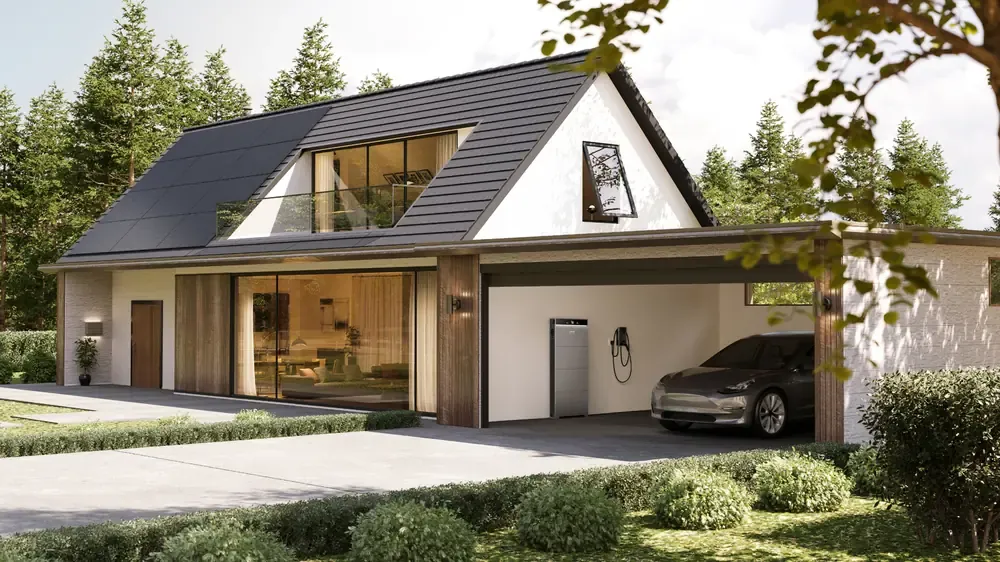
Manufacturer image supplied by Anker SOLIX. Not a SolarFX installation.
One system, not two products
Solar and storage are often sold as separate purchases that happen to arrive on the same lorry. Designed properly they are one system, and the design decisions interact from the first hour of the survey.
The array determines how much surplus there is to store. The battery determines how much of that surplus you keep. The inverter sits between them and sets the limits on both. Get the sizing of one wrong and the other spends its life half-used.
Why the inverter choice comes first
A hybrid inverter handles the panels and the battery in a single unit. The panels produce DC, the battery stores DC, and a hybrid converts once, on the way out to the house. An AC-coupled arrangement converts twice — DC to AC at the solar inverter, AC back to DC at the battery — and loses a few per cent each way.
That efficiency difference is real but modest. The bigger reasons to specify a hybrid when both are installed together are practical:
- One set of controls. Charge windows, discharge limits, export behaviour and tariff schedules configured in one place rather than two systems negotiating with each other.
- One warranty conversation. When something misbehaves, there is no argument about which manufacturer owns the problem.
- Headroom for later. A hybrid sized with spare battery capacity lets you add a second battery module without touching the rest of the system.
The constraint is that hybrids tie you to a battery range the manufacturer supports. We would rather tell you that at design stage than have you discover it in four years.
Sizing the two against each other
We start with your consumption, ideally from half-hourly data rather than an annual total. An annual figure tells you almost nothing useful; the shape of the day tells you everything.
From that shape we work out three numbers. The daily surplus the array is likely to produce in spring and autumn — not midsummer, which flatters everything. The evening and overnight draw the battery has to cover. And the peak power the house pulls when the oven, shower and car charger overlap, because a battery with plenty of capacity and modest output will simply hand the rest back to the grid.
Where those three numbers disagree, the honest answer is that some capacity will be underused in some seasons. That is normal. What we avoid is specifying capacity that is underused in every season.
Notification and approval
Combined systems cross the G98 threshold more often than solar alone. Where total capacity is 16A or less per phase — around 3.68kW on a standard single-phase supply — the installation is notified to the network operator under G98 after commissioning. Above that it is a G99 application, and G99 must be approved before any work happens.
Approval timescales sit with the network operator, not with us. Where a design is close to the threshold we will tell you what the choice costs you in either direction, because occasionally the sensible answer is to apply export limiting and stay simple.
Commissioning is where the value appears
A combined system that is installed correctly and configured lazily performs like a cheaper one. Commissioning sets the charge and discharge windows against your actual tariff, decides what the battery does with a forecast sunny day in April, and sets whether surplus goes to the battery, the car or the grid first.
We set that up with you, show you how to read the monitoring, and revisit it if your tariff or your household routine changes.
Who this is for
- Households out during the day with high evening and overnight consumption
- Homes on, or willing to move to, a time-of-use tariff
- Properties where a single scaffold visit for both trades makes sense
- Owners who want one designer, one installer and one point of accountability
What is included, and what is not
Included as standard
- Consumption analysis using half-hourly data where your meter can provide it
- Combined array and storage design, sized against each other rather than separately
- Hybrid inverter specification and DC coupling of the battery
- Scaffolding, roof works, mounting system and panels
- Battery siting assessment and installation
- DC and AC isolation, protection, metering and labelling
- G99 application to the network operator where the capacity requires it
- Commissioning, tariff configuration and app setup on your devices
- MCS certification and full handover documentation
Not included
- Roof repairs or re-covering needed before the array can go on
- Consumer unit replacement where the existing board cannot be worked with
- Building work to create a suitable battery location
- Whole-home backup wiring beyond the agreed EPS circuits
- Export tariff switching, which remains a contract between you and your supplier
Anything in this column that your property turns out to need is identified at survey and priced in the written quotation, not raised later as a variation.
Timescale
Typically two to four days on site once scaffolding is up, with G99 approval added to the lead time where it applies.
What affects the cost
| Factor | Why it matters |
|---|---|
| Array size in kWp and usable battery capacity in kWh | Assessed at survey and reflected in the fixed written quotation. |
| Whether a hybrid inverter covers both, or a second unit is needed | Assessed at survey and reflected in the fixed written quotation. |
| Continuous and peak power output required from the battery | Assessed at survey and reflected in the fixed written quotation. |
| Roof covering, pitch, height and scaffold requirement | Assessed at survey and reflected in the fixed written quotation. |
| Distance between array, inverter, battery and consumer unit | Assessed at survey and reflected in the fixed written quotation. |
| Whether backup or EPS functionality is specified | Assessed at survey and reflected in the fixed written quotation. |
New to this? Start with how domestic solar works and what battery storage changes, then come back to the detail.
Common questions
Is it cheaper to install solar and a battery together?
Usually, yes, though the saving is in the shared work rather than the equipment. One survey, one scaffold, one electrical connection, one commissioning visit and one set of certification. A hybrid inverter also replaces what would otherwise be two separate inverters if the battery were added later.
Does adding a battery change the network application?
It can. Storage counts towards the capacity you declare to the Distribution Network Operator, so a combined system that would have sat under the G98 threshold on panels alone frequently lands above it. That means a G99 application, which has to be approved before installation rather than notified afterwards.
Should the battery be sized to the array or to the house?
To the house, with the array as a constraint. A battery that is larger than your typical evening consumption sits part-full most nights; a battery larger than your typical daily surplus never fills from solar. The useful size is the smaller of those two numbers, adjusted for what a cheap overnight tariff lets you do in winter.
Can we install the panels now and the battery next year?
Yes, and it is a sensible way to spread the cost. The important decision is made at the first visit: specify a hybrid inverter with the headroom for the battery you expect to add, and leave the cabling route and the space for it. Retrofitting into a system that was never designed for storage costs more and works less well.
Related services
- Solar panel installationSurvey, design, roof works, electrical works and commissioning for a domestic solar PV system.
- Battery storage installationHome battery systems sized against your consumption, sited properly and commissioned with the tariff in mind.
- EV charger installationHome charge points installed with a proper load assessment, PEN fault protection and solar-aware scheduling.
The technology behind it
- Hybrid invertersA single unit managing array, battery and house demand, and when fitting one is worth the extra cost.
- BatteriesHow home storage works, what determines whether it pays, and the specifications that actually matter.
- Battery sizingHow storage capacity and power rating are calculated from consumption data rather than from roof size.
- Solar panelsWhat a domestic solar panel is, how it is built, and which specifications on the datasheet actually matter.
Property and roof guides
See it on a real installation
- Solar, storage and EV charging in Padworth, BerkshireA whole-home energy system on an established tiled roof — solar PV, battery storage, EV charging and a surplus diverter for hot water.
- A complete home energy system in Reading, BerkshireTen panels across a pitched garage roof, battery storage against the wall below, and an EV charger — designed as one system rather than three separate jobs.
Further reading
- What size battery do I need?How evening consumption, array size, tariff and inverter power rating together decide usable battery capacity.
- G98 and G99 DNO applicationsThe 16A per phase threshold, what notification and approval each route requires, and how it affects your install date.
- How much can solar panels save?The factors that determine a solar saving, the assumptions any estimate must state, and how to read a quotation critically.
Where we work
Information reviewed on 2026-08-23.
Book a free design and quotation
Tell us about the property and we will arrange a survey, then issue a written design and fixed quotation before any work is agreed.
Enquire about solar and battery systems
No obligation. We will review the details, come back to arrange the next step, and issue a written design and fixed quotation before anything is agreed.
Prefer to talk? Call 0118 227 7444.