
East Horsley, Surrey
A battery upgrade that became a full system rebuild
The enquiry was for another 15kWh of storage. The survey found four roof orientations sharing two MPPTs, and the honest answer was to rebuild from the roof upwards.
- Installation under way
- Complete solar PV and battery redesign
- Approximately 30kWh, ground level
- Two 6kW units operating in parallel
- New 480W panels on a new in-roof system
Photographs from the installation
Every photograph below is from this job in East Horsley. The installation is still under way.
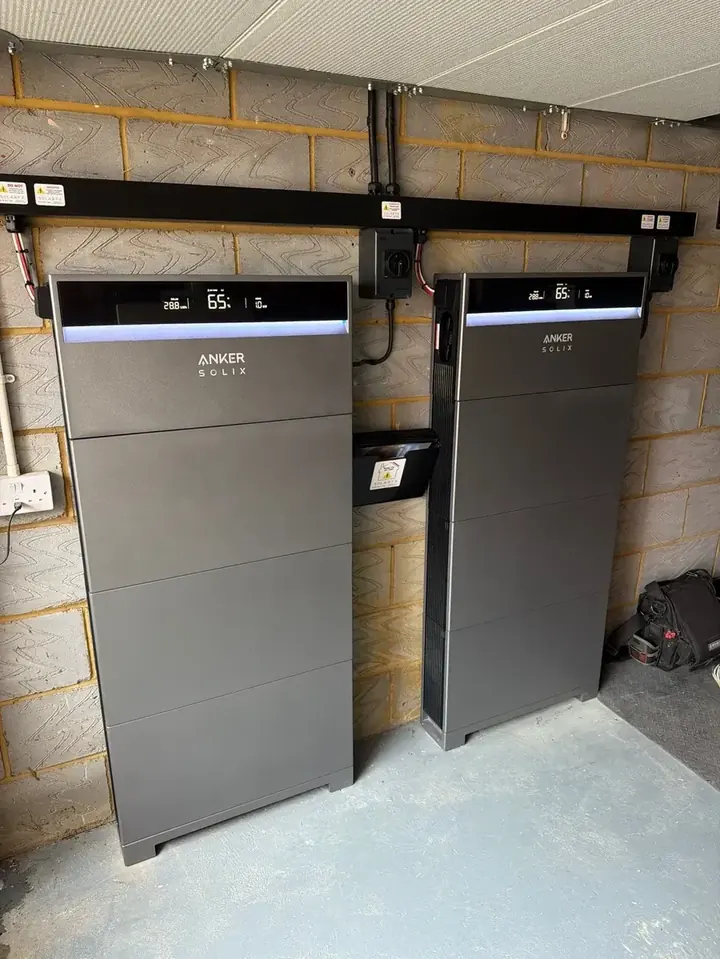
The replacement storage at ground level in a dedicated location — around 30kWh, rather than more modules added to the loft. 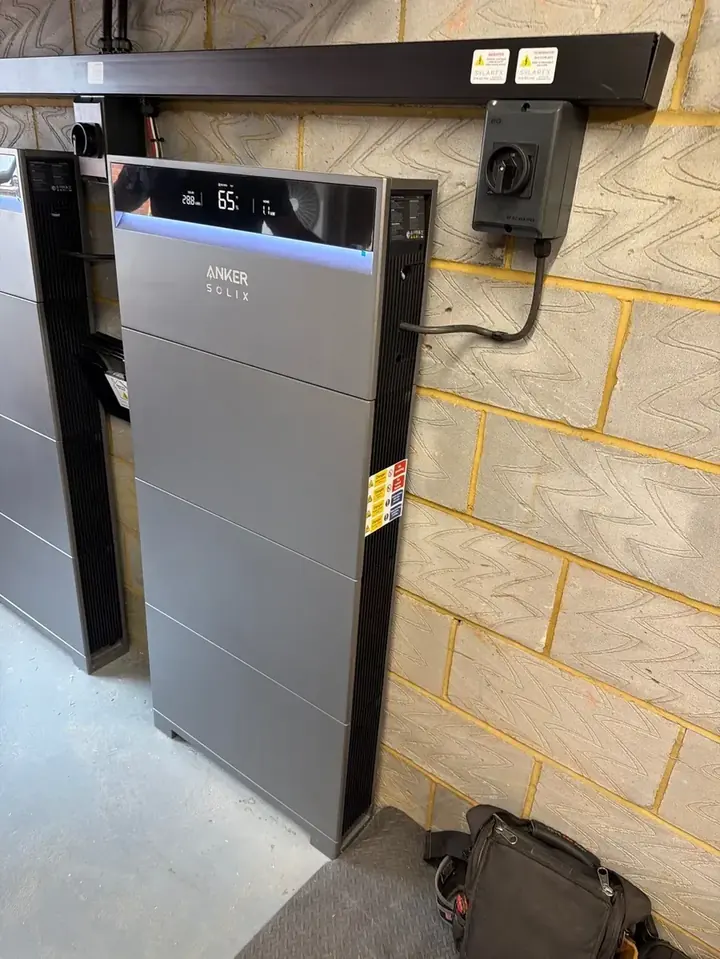
The storage sited with room to work around it, and the associated electrical equipment run overhead on a dedicated tray. 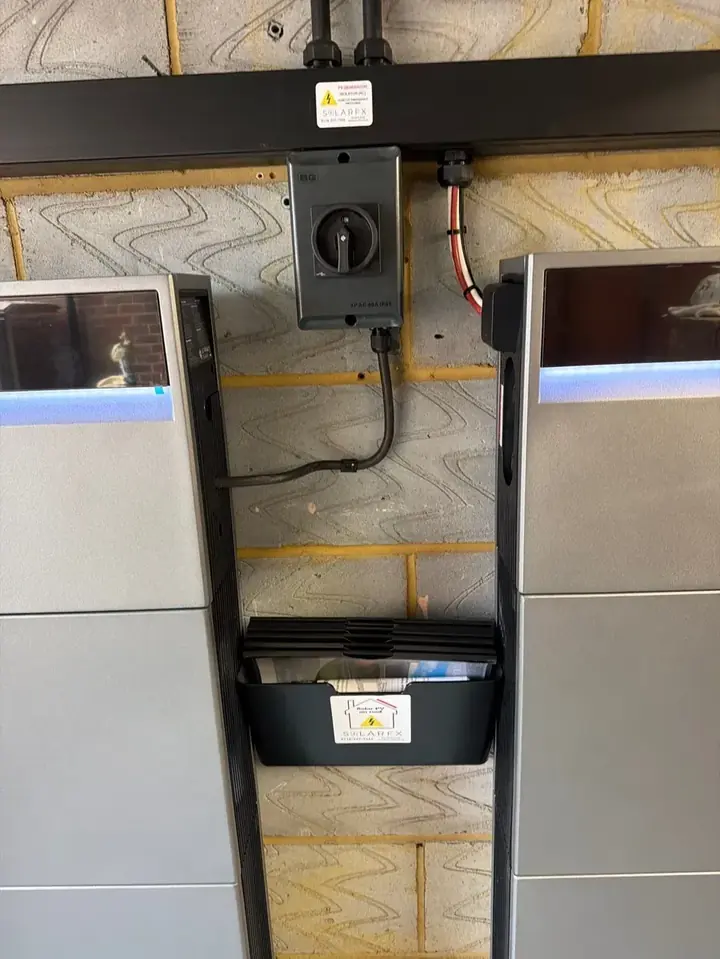
Isolation and protection equipment positioned alongside the storage rather than scattered across the building. 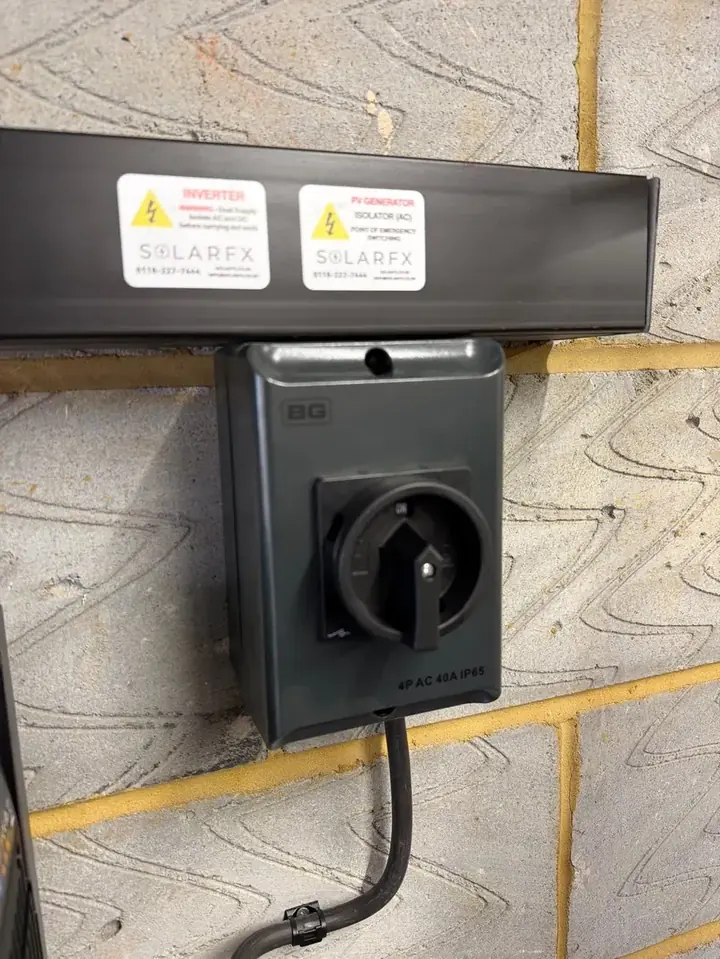
Inverter and PV generation isolation, labelled — part of correcting an installation whose original cabling had been left unrouted. 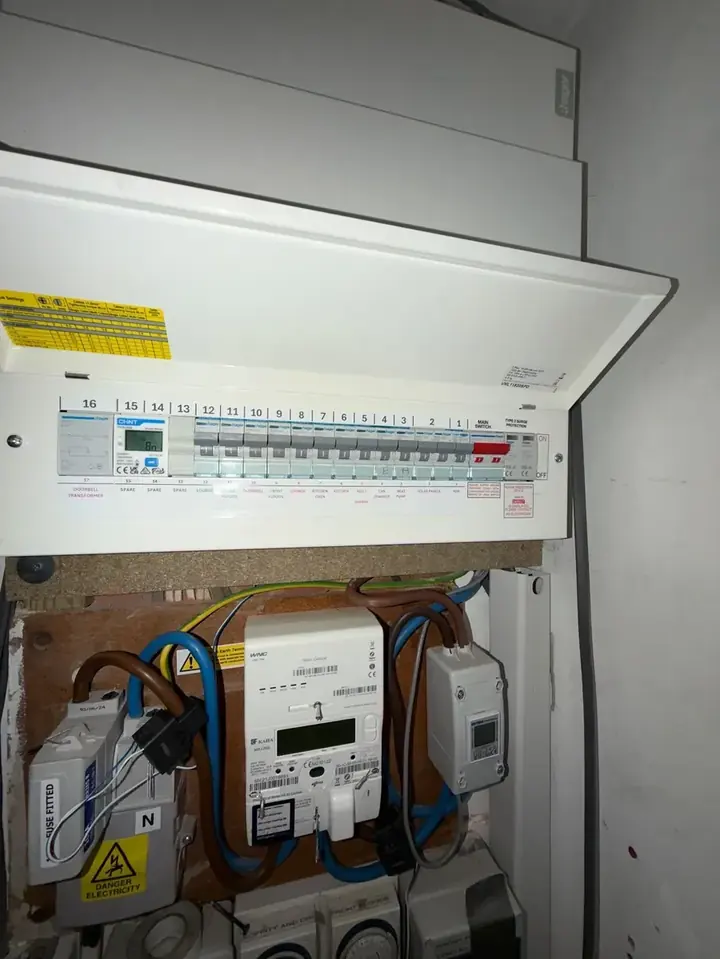
Consumer unit and metering, where the rebuilt system integrates with the existing supply.
What was already there
The original system dated from the period after 2020 when solar equipment was hard to get hold of: a string inverter with an AC-coupled battery system made up of three 5kWh modules. The individual components came from established manufacturers — the problem was how the system as a whole had been designed and installed.
The newer battery equipment was not compatible with the existing modules, so the requested 15kWh simply could not be added. The old batteries also sat in the loft, and we were not willing to put more storage up there.
What the survey found
Loose DC cabling. The DC runs from the panels had been left lying across the loft rather than routed and clipped properly.
Different roof orientations on the same tracker. This was the significant one. The house has panels on four elevations, and they had been wired north with east, south with west, then combined into the inverter’s MPPT inputs.
An MPPT — Maximum Power Point Tracker — constantly adjusts the operating voltage of an array to find the point where it produces the most power. Put panels facing very different directions on the same tracker and they see completely different light through the day, which makes finding a good operating point for either of them impossible. The system could not perform the way it should.
Irregular performance. Monitoring showed inconsistent output and odd voltage behaviour, which is what prompted us to look harder at both the roof and the electrical side.
The in-roof system itself. Inspecting the roof raised concerns about how the existing in-roof installation had been fitted. After talking it through with the homeowner, we agreed to take the solar off and rebuild from the roof upwards rather than try to modify something with fundamental problems.
The redesign
Around 30kWh of storage. Rather than extending the old arrangement, it is being replaced with one modern system, installed at ground level in a dedicated location instead of the loft.
Two 6kW inverters in parallel, configured as master and secondary. That gives four independent MPPT inputs, so the north, east, south and west arrays each get their own tracker and can each run at the voltage that suits the light they are actually receiving. It is the single biggest improvement over the original design.
New 480W panels on a completely new in-roof mounting system. Rebuilding the array meant we could correct the configuration rather than compromise a new system by keeping poorly configured parts of the old one.
Why the survey mattered
This is the clearest example we have of why an existing system should be surveyed properly before anything is added to it. Had we simply connected the extra storage the homeowner originally asked for, every underlying problem — the array configuration, the cabling, the roof system — would still be there, now powering a bigger battery.
Adding storage to an older installation is not always as simple as connecting another battery. Compatibility, inverter capacity, panel configuration, cable installation and the condition of the existing system all need to be considered first.
Certification
On completion the installation will be issued with an Electrical Installation Certificate, solar PV documentation covering the array, and a Building Regulations notification.
We work across this area regularly. What we install in Guildford.
Related services
- Battery retrofitAdding storage to a solar system that is already on the roof, without disturbing what works.
- Solar health checkA one-off independent assessment of an existing system, with a written report on its condition and performance.
- Solar panel removal and refitTaking an array down for roof work, extensions or repairs, and putting it back properly afterwards.
- In-roof solarPanels integrated into the roof covering rather than mounted above it, with the weathering detailed properly.
- Battery storage installationHome battery systems sized against your consumption, sited properly and commissioned with the tariff in mind.
The technology behind it
- Hybrid invertersA single unit managing array, battery and house demand, and when fitting one is worth the extra cost.
- Power optimisersPer-panel DC electronics that keep conversion in one accessible box: the middle option between string and micro.
- BatteriesHow home storage works, what determines whether it pays, and the specifications that actually matter.
- Battery sizingHow storage capacity and power rating are calculated from consumption data rather than from roof size.
- Mounting systemsHooks, rails, clamps and fixings — the part of the installation that decides whether the roof stays watertight.
Property and roof guides
Further reading
- Adding a battery to existing solarAC coupling versus replacing the inverter, what a retrofit survey checks, and the network paperwork it can trigger.
- Signs your solar system is underperformingHow to tell a genuine fault from normal seasonal variation, and the checks worth doing before calling anyone out.
- String inverter vs microinvertersHow central and module-level conversion differ in shading tolerance, servicing, monitoring and failure behaviour.
Where we work
Want something similar?
Every system is designed around the property in front of us. Tell us the postcode and what you are trying to achieve.