
Technology
String Inverters
The conventional central inverter: how strings are designed, where it is the best value, and where it is the wrong choice.
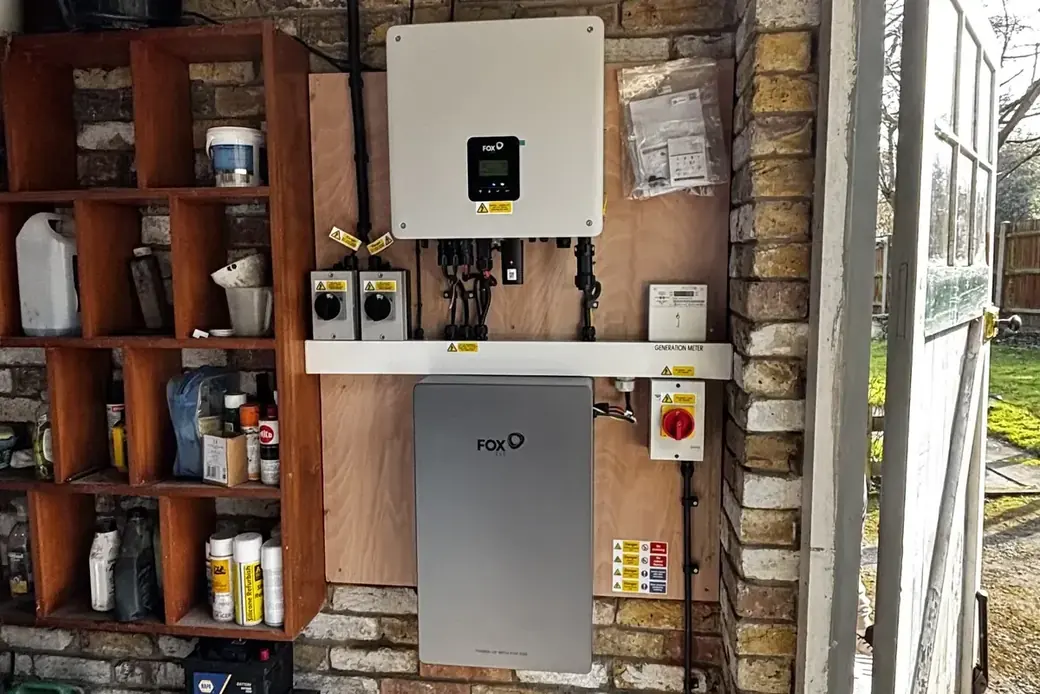
What a string inverter is
One box, usually the size of a small briefcase, mounted on a wall. The panels are wired in series into a string — positive of one to negative of the next — and the string arrives at the inverter as a single DC circuit at a few hundred volts. The inverter converts it to 230V AC and feeds it into the consumer unit.
This is the original architecture and still the most common. It remains the default for good reasons rather than habit.
How a string is designed
Series wiring adds voltage. Ten panels at roughly 40V open circuit produce roughly 400V; twenty produce 800V. Two constraints bound the design.
The upper limit is the inverter’s maximum DC input voltage. Panel voltage rises as temperature falls, so the string must stay within that limit on the coldest bright morning of the year, not at the temperature on survey day. This is why string lengths are calculated against a design minimum temperature rather than estimated.
The lower limit is the inverter’s start-up and MPPT operating voltage. Too short a string and the inverter will not begin generating until later in the morning, and will drop out earlier on dull days.
Between those, the designer chooses panel counts per string that fit the roof geometry and the tracker allocation.
MPPT and orientation
Each MPPT input holds everything connected to it at one operating voltage, chosen to maximise power from that group. That is fine when the group behaves as one. It is not fine when it does not.
Put an east-facing string and a west-facing string on the same tracker and the tracker settles on a compromise. In the morning the east array wants a different voltage from the west array, and neither gets it. Split them onto separate trackers and each finds its own peak independently. So the practical rule is one tracker per orientation, and an inverter with two or three MPPT inputs is what makes a split-roof design work properly.
Where it is the right choice
An unshaded roof, one or two orientations, no more strings than the inverter has trackers. That describes the majority of UK domestic installations, and on those roofs a string inverter produces essentially the same annual yield as any other architecture for less money and with fewer components on the roof.
It is also the right choice when serviceability matters. Everything is in one accessible unit. A fault is diagnosed from the display or the app, and a replacement takes a morning without scaffolding.
Where it is the wrong choice
Where shading falls across part of the array for a meaningful part of the day. Where the roof breaks into several small arrays at different angles and the tracker count cannot cover them. Where the owner does not want high-voltage DC running from the roof through the loft. In those cases optimisers or microinverters are worth their cost, and we will say so.
Installation implications
Siting is the main decision. Ventilated, accessible, protected from direct sun, and close enough to both the array and the consumer unit to keep cable runs sensible. Lofts work but run hot in summer, and heat shortens electronic life. DC isolation is required at the inverter and, depending on the design, at the array. Everything gets labelled so the next electrician can see what is in front of them.
Cost and warranty
A string inverter is the cheapest way to convert an array, and on a straightforward roof the saving against per-panel electronics is significant enough to fund other parts of the project. Warranty terms differ substantially between manufacturers, and paid extensions are commonly available at the point of purchase — worth considering, because this is the component most likely to be replaced first. The exact term, conditions and extension pricing appear on the datasheet and in your written quotation.
Specification considerations
These are the figures worth comparing when you are reading a quotation. The exact values for the products specified for your installation come from the manufacturer's current datasheet and are stated in your written quotation.
| What to look at | Why it matters |
|---|---|
| Topology | Panels wired in series into one or more strings, converted by a single central unit |
| Typical domestic rating | From around 3kW to 6kW single-phase for a normal house; larger units available three-phase |
| MPPT inputs | Commonly one to three independent trackers, each carrying one or more strings |
| String voltage | Determined by panel count and coldest expected temperature; must stay within the inverter's maximum input voltage |
| DC on the roof | Present — the string operates at high DC voltage from the array to the inverter |
| Location | Loft, garage, utility or external wall depending on the ingress and temperature rating |
| Serviceability | One accessible unit; replacement does not require roof access or scaffolding |
Where it works, and where it does not
Strengths
- Lowest cost per watt of any inverter architecture, which shows directly in the quotation
- Fewest components and fewest connections, so fewer things to go wrong
- All electronics at ground or loft level, so faults are diagnosed and replaced without scaffolding
- Straightforward fault-finding — one unit reporting one set of errors
- Well understood by any competent installer, so future service is not tied to a specialist
Limitations
- A series string performs to the level of its weakest panel, so partial shading costs more than the shaded area alone
- A single unit is a single point of failure for the entire array
- Limited MPPT inputs constrain how many roof orientations can be handled properly
- High-voltage DC runs from the roof to the inverter, which some owners prefer to avoid
- String length is bounded by voltage limits, which reduces layout flexibility on awkward roofs
This page covers one component. For how the whole thing fits together, see solar panels and battery storage.
Common questions
Is a string inverter worse than microinverters?
No — it is better on most roofs. On an unshaded roof with one or two orientations, a string inverter produces effectively the same annual generation for meaningfully less money, with fewer components and easier servicing. Microinverters earn their extra cost where shading or fragmented arrays make per-panel independence genuinely valuable. Paying for that on a clear south-facing slope is spending money for nothing.
What happens if one panel is shaded?
Current through the whole series string drops toward the level the shaded panel can pass. Bypass diodes in each panel limit the damage by routing current around the affected cell group, and half-cut cell construction limits it further, but the string still loses more than the shaded panel's share. Where that happens for a meaningful part of the day, optimisers on the affected panels are the usual answer.
Can I add a battery later to a string inverter?
Yes, using AC coupling — a separate battery inverter connected on the AC side, working alongside the existing unit. It works well and avoids replacing equipment that is doing its job. It involves a small round-trip conversion loss and a second piece of equipment compared with a hybrid, so if a battery is likely within a few years it is usually cheaper to fit a hybrid at the outset.
How long will it last?
Less time than the panels. The inverter is the component most likely to need replacing during the system life, and heat is the main enemy — a unit in a hot loft works harder than the same unit in a cool garage. Warranty lengths vary by product and extensions are often available at purchase; the terms for the unit we quote are on its datasheet.
Related services
- Solar panel installationSurvey, design, roof works, electrical works and commissioning for a domestic solar PV system.
- Inverter replacementReplacing a failed or ageing inverter, matched to the array that is already on the roof.
- Solar health checkA one-off independent assessment of an existing system, with a written report on its condition and performance.
The technology behind it
- InvertersWhat the inverter does, how MPPT works, and how the four architectures compare honestly against each other.
- Hybrid invertersA single unit managing array, battery and house demand, and when fitting one is worth the extra cost.
- MicroinvertersOne inverter per panel mounted on the roof: what per-panel conversion buys, and what it costs.
- Power optimisersPer-panel DC electronics that keep conversion in one accessible box: the middle option between string and micro.
- Solar panelsWhat a domestic solar panel is, how it is built, and which specifications on the datasheet actually matter.
Property and roof guides
- Post-1965 homesTrussed rafter roofs, concrete interlocking tile and modern electrics — the most straightforward housing stock to work on.
- 1930s semi-detached homesThe classic suburban semi — hipped or gabled roof, party wall stack, bay window and a side elevation that changes everything.
- BungalowsLarge roof area over a small floor plan, low eaves and easy access — with shading and consumption as the real limits.
See it on a real installation
Further reading
- String inverter vs microinvertersHow central and module-level conversion differ in shading tolerance, servicing, monitoring and failure behaviour.
- Adding a battery to existing solarAC coupling versus replacing the inverter, what a retrofit survey checks, and the network paperwork it can trigger.
- Signs your solar system is underperformingHow to tell a genuine fault from normal seasonal variation, and the checks worth doing before calling anyone out.
Where we work
Information reviewed on 2026-08-23.
Not sure which specification suits your roof?
We design around the property rather than fitting the same system to every house. Tell us the postcode and we will explain what we would specify and why.
Ask us about specification
No obligation. We will review the details, come back to arrange the next step, and issue a written design and fixed quotation before anything is agreed.
Prefer to talk? Call 0118 227 7444.